Kidney Stones: Causes, Symptoms, Diagnosis & Treatment
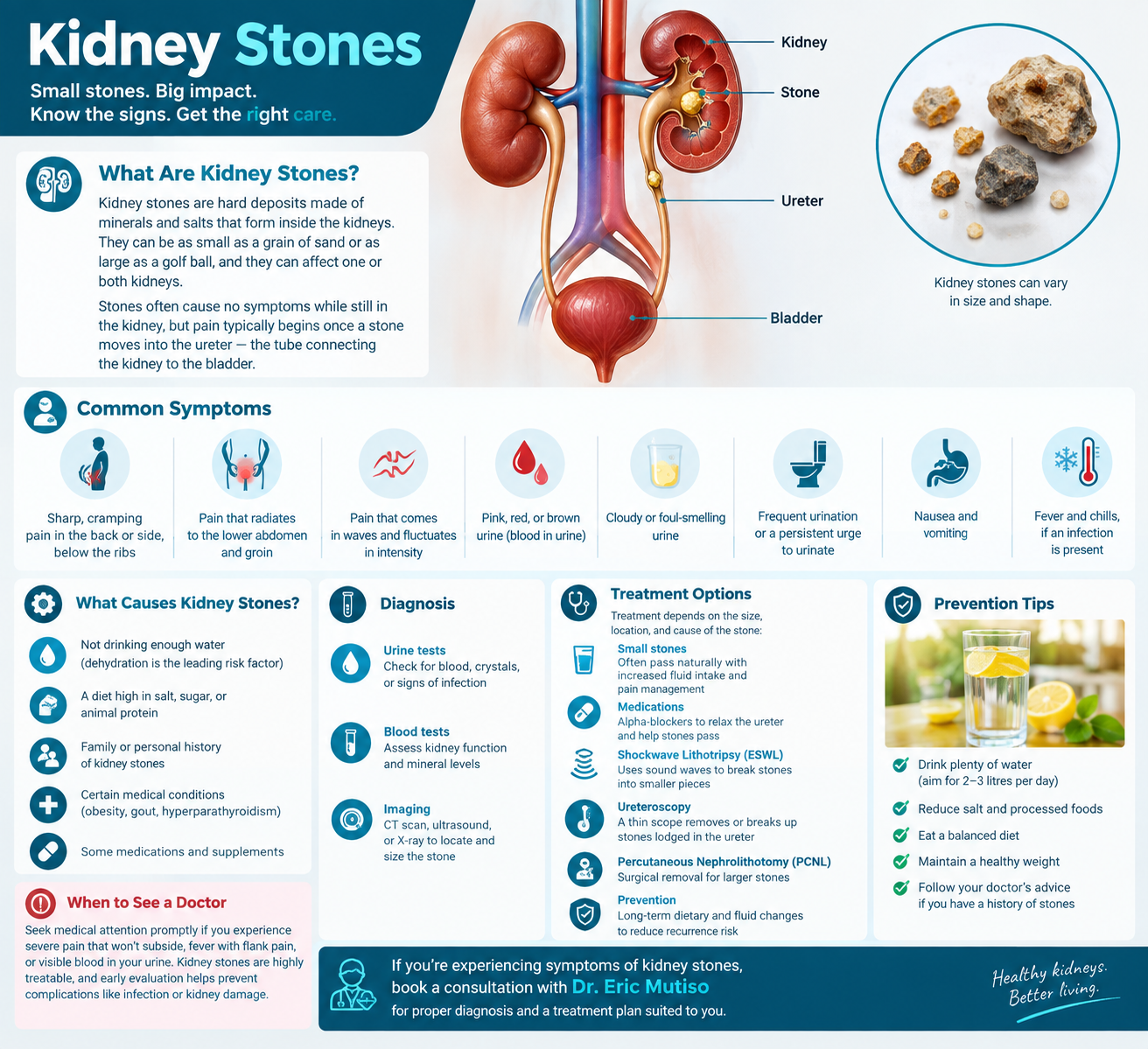
🔹 What Are Kidney Stones? Kidney stones are hard deposits made of minerals and salts that form inside the kidneys. They can be as small as a grain of sand or as large as a golf ball, and they can affect one or both kidneys. Stones often cause no symptoms while still in the kidney, but pain typically begins once a stone moves into the ureter — the tube connecting the kidney to the bladder. 🔹 Common Symptoms Sharp, cramping pain in the back or side, below the ribs Pain that radiates to the lower abdomen and groin Pain that comes in waves and fluctuates in intensity Pink, red, or brown urine (blood in urine) Cloudy or foul-smelling urine Frequent urination or a persistent urge to urinate Nausea and vomiting Fever and chills, if an infection is present 🔹 What Causes Kidney Stones? Not drinking enough water (dehydration is the leading risk factor) A diet high in salt, sugar, or animal protein Family or personal history of kidney stones Certain medical conditions (obesity, gout, hyperparathyroidism) Some medications and supplements 🔹 Diagnosis Urine tests: Check for blood, crystals, or signs of infection Blood tests: Assess kidney function and mineral levels Imaging: CT scan, ultrasound, or X-ray to locate and size the stone 🔹 Treatment Options Treatment depends on the size, location, and cause of the stone: Small stones: Often pass naturally with increased fluid intake and pain management Medications: Alpha-blockers to relax the ureter and help stones pass Shockwave Lithotripsy (ESWL): Uses sound waves to break stones into smaller pieces Ureteroscopy: A thin scope removes or breaks up stones lodged in the ureter Percutaneous Nephrolithotomy (PCNL): Surgical removal for larger stones Prevention: Long-term dietary and fluid changes to reduce recurrence risk 🔹 When to See a Doctor Seek medical attention promptly if you experience severe pain that won't subside, fever with flank pain, or visible blood in your urine. Kidney stones are highly treatable, and early evaluation helps prevent complications like infection or kidney damage. If you're experiencing symptoms of kidney stones, book a consultation with Dr. Eric Mutiso for proper diagnosis and a treatment plan suited to you.
Have A Question About This?
Reach out to Dr. Mutiso directly for personalised advice.
0 Comments
Be the first to share your thoughts or ask a question below.
Leave a Comment